
The Birth of NATO’s Cyber Defence.
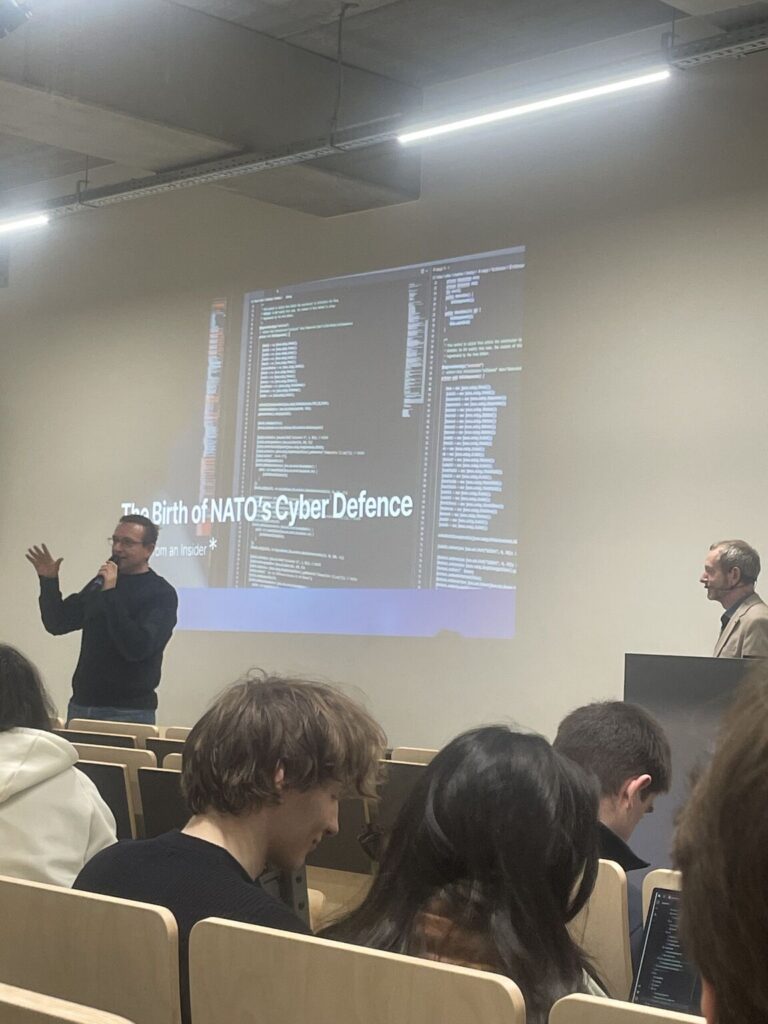
NATO isn’t just tanks and planes, it’s also ones and zeroes
When I signed up for this Tech&Meet session, I didn’t really know what to expect. The topic was NATO and cyber defense, which sounded interesting but also quite far removed from everyday life. After listening to Martin De Pauw, I realized how relevant it actually is.
Cyber has no borders
One thing that stood out to me was the idea that cyberattacks don’t respect borders. Anyone connected to the internet can be affected, whether they are part of a government, a company, or just an individual user. The digital world connects everyone, but it also exposes everyone to risks.
Martin explained how NATO’s view on cybersecurity has changed over the years. What was once seen as a niche IT concern has become a major part of modern defense. In 2016, NATO officially recognized cyberspace as a domain of operations alongside land, sea, and air.
Zero Trust as a mindset
Martin also discussed the concept of Zero Trust. His main message was simple: don’t assume something is trustworthy just because it is within your network. Everything should be verified.
He also emphasized that security should be considered from the very beginning of a project rather than as something that can be added afterwards.
People are still the weakest link
Another point that caught my attention was the importance of people in cybersecurity. Even organizations with advanced technology and large security teams still have to deal with human mistakes.
Training and awareness remain essential because technology alone cannot prevent every security incident. Human error remains one of the biggest challenges in cybersecurity.
Resilience over perfection
The takeaway that resonated most with me was the idea of resilience. Martin explained that achieving perfect security is impossible. Instead, organizations should focus on being prepared for incidents, responding effectively, and recovering quickly when something goes wrong.
He also mentioned frameworks such as the NIST Cybersecurity Framework, which help organizations structure their approach to identifying risks, protecting systems, detecting threats, responding to incidents, and recovering afterwards. Having a plan in place and being able to continue operating after an attack is often more important than eliminating every possible risk.
Final thoughts
Overall, I expected a technical presentation on military cyber operations, but it turned out to be much broader. It gave me a better understanding of why cybersecurity matters to everyone, not just governments and defense organizations.
It was also interesting to hear about Martin’s own career path, from working on F-16 avionics systems to becoming involved in cyber defence.